Julia Leigh: Letter Transcription
Family Correspondence and Historical Context in the Leigh Family Papers
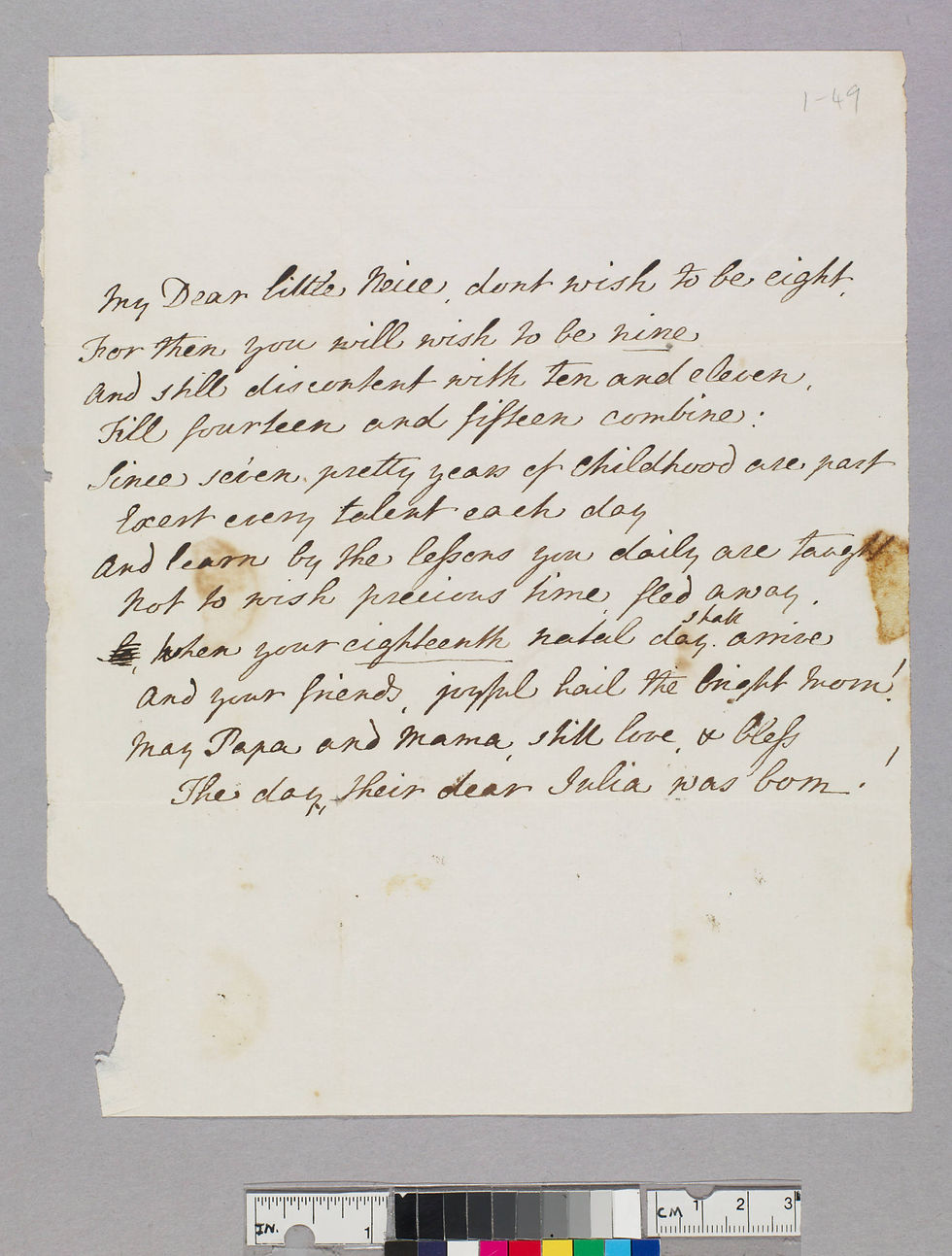
Figure 1. My Dear Little Neice, Don't Wish to be Eight, Leigh family papers, The Huntington Library, San Marino, CA.
Abstract
This composition was created for English 535: Studies in Jane Austen. The assignment focused on paleography and archival research. The assignment required me to introduce, transcribe and annotate a selected archival letter from the Huntington Library’s Leigh Family Papers collection. The selected archival letter was written by Miss Julia Leigh to her niece on the occasion of her eighth birthday. For this project, I worked to accurately interpret historical handwriting, provide a concise contextual and historical introduction to the document and annotate references that may help modern readers better understand the document and the meaning behind it. This sample highlights my abilities in transcription, text analysis, historical and contextual interpretation and reflects a preliminary interest in working with archival materials.
Leigh, Elizabeth. “My Dear Little Neice, don’t wish to be eight…” [poem] [1797-1798?]. Leigh Family Papers. Huntington Family Papers. Library, San Marino, CA. Manuscript
Introduction:
This manuscript poem from the Leigh Family Collection, was written by Elizabeth Leigh for her niece, Julia Leigh Colvile, in 1797 or 1798 for the occasion of her eighth birthday. This poem embraces a warm tone and playfully advises Julia to enjoy her childhood while it lasts. Elizabeth Leigh plays on childhood desires to be older and continues through each age until eighteen and suggests that it is better to be happy with the age a person is than to always look forward to the next. The poem also speaks of the lessons that are learned each day in childhood. The mention of the recipient’s eighteenth birthday marks the end of childhood and the beginnings of adulthood. In the eighteenth-century framework, the beginnings of adulthood carried social expectations and pressures as well as family expectations such as marriage. This piece has importance for readers of Jane Austen because it illustrates the culture of writing and gives insight into Austen’s extended family. It connects the Leigh family to Jane Austen through her maternal family line. Similar to Jane Austen’s early writings, such as Juvenilia, which were distributed within her family circles, this poem is an example of Austen’s extended maternal family line’s writing culture and that of the wider literary landscape in the 1790’s where family would often write to celebrate momentous occasions. This also demonstrates how private texts could combine whimsy, affection, and social expectations.
Outside Inscription:
Written by Mrs Elizabeth Leigh[i] upon my 7th birth
[day][ii] upon my [impressing] wish to be 8___
Written Manuscript:
My Dear little Neice[iii], dont wish to be eight,
For then you will wish to be nine
And still discontent with ten and eleven,
Till fourteen and fifteen combine:
Since seven, pretty years of childhood are past
Exert every talent each day
And learn by the lessons you daily are taught
Not to wish precious time fled away.
When your eighteenth natal day[iv] shall arrive
And your friends, joyful hail the bright morn!
May Papa[v] and Mama[vi], still love & bless
The day their dear Julia[vii] was born!
[i] Elizabeth Leigh, 1735-1816, was Cassandra Leigh Austen’s cousin on the Leigh side. She was Cassandra Austen’s (Jane’s sister) godmother. (Faye) Miss Elizabeth Leigh resided at Adlestrop with her brother, Reverend Thomas Leigh, Adlestrop rector. She was referred to as Mrs Elizabeth Leigh in Jane Austen’s letters and in the outside transcription, as this was the custom of address in this period for ladies of a certain age, regardless of their marital status. (The Jane Austen Society)
[ii] Birthday manuscript verse- this poem is an occasional verse, an eighteenth-century tradition where poems were written to commemorate noteworthy events. (Schellenberg)
[iii] Neice- during this period in history spelling conventions were more flexible than they are today. Words that are commonly spelled with “ie” now were often spelled with “ei” other authors also used this spelling conventions in this period. (Austen)
[iv] Eighteenth natal day- natal day is an older way of saying birthday. This line seems to suggest that Julia’s eighteenth birthday will be a transition from childhood to adulthood. (Oxford English Dictionary)
[v] James Henry Leigh,1765-1823, was the father of Julia Leigh Colvile. Related to Jane Austen on the maternal Leigh side. (Faye)
[vi] Julia Judith Twisleton Leigh1771-1843, was the mother of Julia Leigh Colvile and wife to James Henry Leigh. (Faye)
[vii] Julia Leigh Colvile, 1793-1843, was the poem’s recipient. She was the daughter of James Henry Leigh and Julia Judith Twisleton Leigh. (Faye)
Works Cited
Austen, Jane. Jane Austen's Manuscript Works. Ed. Linda Bree, Peter Sabor and Janet Todd. Ontario: Broadview Editions, 2013.
Faye, Deidre Le. Jane Austen A Family Record. New York: Barnes & Noble Books, 1989.
Huxley, Victoria. Jane Austen & Adlestrop: Her Other Family. Adlestrop: Windrush Publishing Services, 2013.
Oxford English Dictionary. Nativity, n. 2026. 28 3 2026.
Schellenberg, Betty. "Introduction: The Litrary Coterie in the EIghteenth-Century Media Landscape." Literary Coteries and the Making of Modern Print. Cambridge: Cambridge University Press, 2016. 1-24. Print.
The Jane Austen Society. "Report for 2006." 2006.